

Stuck
US-Iran Negotiations Have Stalled, Leaving Trump with Only Bad Options

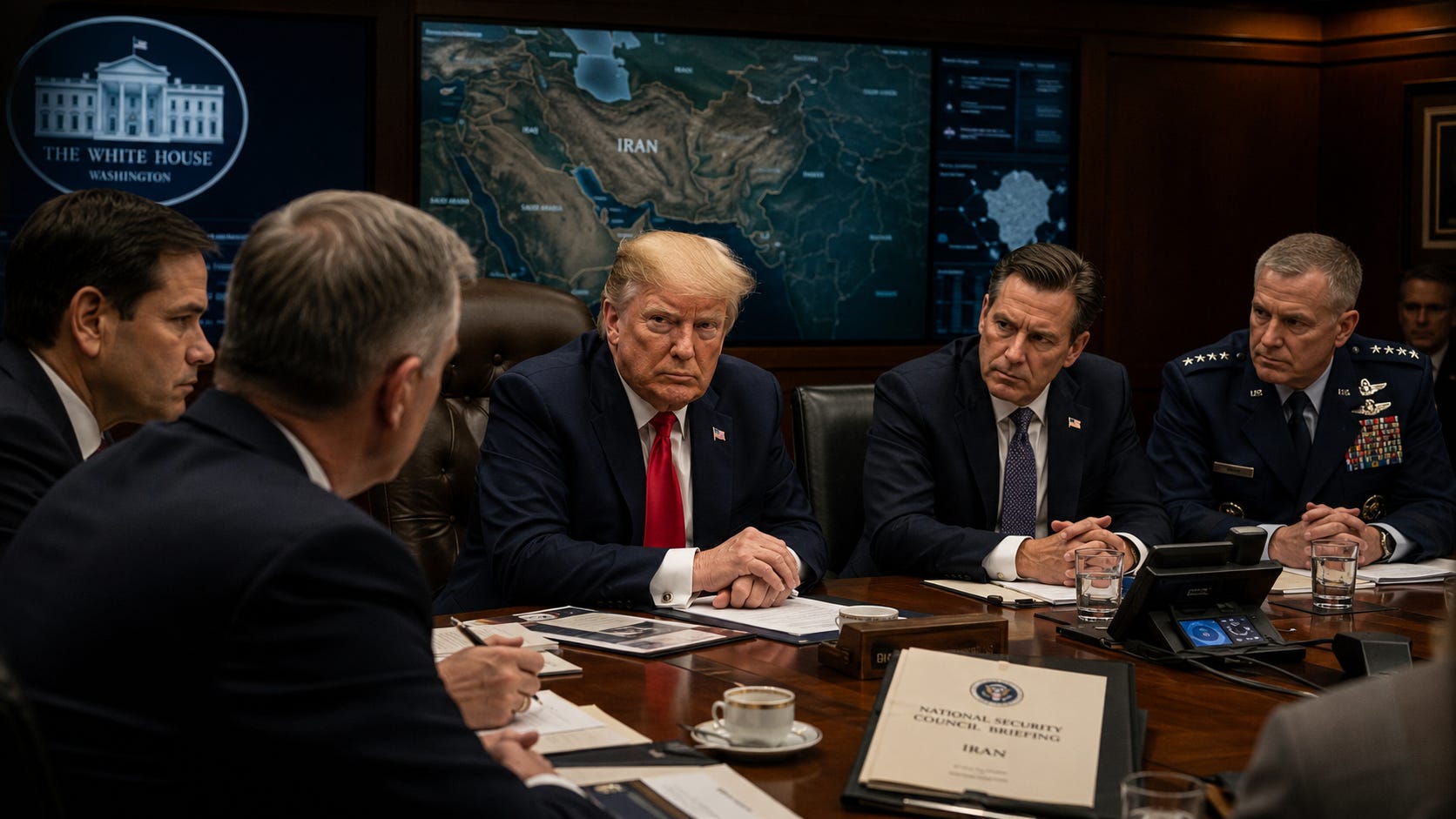
Three months into the most consequential US military campaign in the Middle East since the 2003 invasion of Iraq, President Trump is stuck. Operation Epic Fury destroyed Iran’s air defenses, shattered its navy, killed Supreme Leader Khamenei, and decimated the senior ranks of the Islamic Revolutionary Guard Corps. By any military measure, the campaign succeeded. But military success has not produced political resolution. The Strait of Hormuz remains effectively closed. Iran retains roughly 440 kilograms of enriched uranium—enough, if enriched further, for eleven nuclear weapons. A fragile ceasefire declared on April 8 has been violated repeatedly by both sides. And the negotiations that were supposed to convert battlefield leverage into a durable settlement have stalled, Treasury Secretary Bessent yesterday said enigmatically that there are “the makings of a deal” but so far the President has not confirmed whether or not he will accept it. The administration has been at the one-yard line of a deal for weeks, probably because they have been grappling with the reality that the President has only a few viable options going forward—none of them good.
Further delaying a decision on a deal carries its own risks. The US and other Western nations have been able to avoid significant energy price increases mostly by drawing down reserves of petroleum. But yesterday a senior VP with Exxon said global oil inventories are “approaching unheard of levels” and warned they will be essentially depleted within three weeks, leading to rapid price increases to $150 or $160 per barrel. The Strait of Hormuz either gets opened soon, or the global economy faces a severe recession starting this summer. The President undoubtedly knows this; the question for him and his national security team essentially boils down to which option gets the Strait open at the least cost to US security objectives and to the President’s political priorities. None of the available options entail “no cost”; the debate that I imagine is going on in the White House today is how much cost to bear, and who — the President, US national security interests, regional allies, or the global economy — should bear them.
The Talks So Far: Close but Not There
The diplomatic trajectory since the ceasefire has followed a pattern of false starts and mutual recrimination. Pakistan brokered the initial ceasefire on April 8, and the Islamabad Talks on April 11–12 attempted to establish a framework for a permanent settlement. Those talks collapsed when the two sides rejected each other’s proposals. Iran submitted a 10-point plan demanding continued control of the Strait of Hormuz, full US military withdrawal from the Gulf, and the lifting of all sanctions. Washington demanded zero uranium enrichment, surrender of Iran’s enriched uranium stockpile, and the reopening of the Strait with no conditions.
When diplomacy failed, the US escalated. On April 13, the Pentagon imposed a naval blockade on Iranian ports—the first American naval blockade of a sovereign nation since the Cuban Missile Crisis. The blockade interdicts all vessels entering or leaving Iranian ports and has cost Iran an estimated $500 million per day, according to US officials.
Since then, Pakistani and Qatari mediators have shuttled between Washington and Tehran, exchanging proposals and counterproposals. On May 23, Trump declared a deal “largely negotiated” and said it would be announced shortly. Within hours, Iran’s Fars news agency dismissed the claim as “incomplete and inconsistent with reality.” A senior Iranian source told Reuters that Tehran had not agreed to hand over its enriched uranium—the single demand Washington has called non-negotiable.
By May 25, both sides were walking back expectations. Secretary of State Marco Rubio told reporters in New Delhi that the US would give diplomacy every chance before exploring “alternatives.” Iran’s foreign ministry said a framework had been reached on some issues but that no one should expect an imminent agreement. The nuclear question, Iran insisted, was not part of any preliminary deal.
The broad outlines of a two-phase framework are visible. Phase one would extend the ceasefire, reopen the Strait of Hormuz with no tolls, clear Iranian mines from the waterway, and lift the US blockade on Iranian ports. In exchange, Iran would be permitted to sell oil freely under limited sanctions waivers. Phase two—a 30-to-60-day negotiation—would tackle the nuclear program, ballistic missiles, and a permanent settlement. But the outlines are where agreement ends and the gaps are where it breaks down.
The gaps are enormous. Trump told PBS News on May 27 that Iran would surrender its enriched uranium and receive no sanctions relief. Iran’s Atomic Energy Organization has said the country will not accept limits on enrichment. The US demands zero enrichment for 20 years. Iran has countered with five. Washington insists the naval blockade stays until a deal is signed. Tehran calls the blockade an act of war that must end before serious negotiations begin. Trump has threatened to “blow up” Oman if it cooperates with Iran on joint Strait management. Iran insists the Strait belongs to its coastal states.
The assassination of Ali Larijani—Iran’s most experienced diplomatic operator and the secretary of the Supreme National Security Council—during the March 18 escalation removed one of the few Iranian officials with the stature and pragmatic temperament to cut a deal. His replacement on the negotiating side, parliament speaker Mohammad Baqer Qalibaf, lacks Larijani’s international relationships and carries more ideological baggage. On the US side, special envoy Steve Witkoff remains the lead, working through Pakistani intermediaries who lack the leverage to bridge the fundamental disagreements.
This is where things stand at the end of May 2026: a ceasefire that neither side fully observes, a framework that neither side fully accepts, and a set of core demands that neither side shows any willingness to abandon. The war has settled into a costly stalemate—military operations paused but not ended, economic damage compounding daily, and the political clock ticking in Washington. Realistically, Trump now faces three options.
Option One: Declare Victory and Walk Away
The simplest path is the one Trump has already been teasing. Declare that Operation Epic Fury accomplished its objectives—Iran’s military is destroyed, its leadership decimated, its nuclear infrastructure damaged—and move on. Accept whatever partial agreement can be reached on the Strait, pocket the military achievements, and pivot to domestic politics before the midterm elections in November.
The case for this option rests on real accomplishments. Iran’s air force and navy are effectively gone. The IRGC’s command structure has been gutted. The strikes destroyed missile production facilities, air defense networks, and significant portions of Iran’s nuclear infrastructure. These are facts, and they represent a genuine degradation of Iran’s ability to threaten the region. In purely military terms, Operation Epic Fury delivered more damage to the Islamic Republic than anything in its 47-year history.
The economic argument is equally pressing. Gas prices have surged from under $3 a gallon before the war to $4.55 nationally as of late May. Eighty-one percent of Americans say the cost of gas is straining their household budgets. Trump’s approval rating has sunk to 37 percent, with only 35 percent approving of his handling of the economy. Republican disapproval of Trump’s economic stewardship reached a record 37 percent in a May AP/NORC poll. Democrats hold a significant lead in generic midterm ballot tests. Every day the Strait stays closed, the political damage compounds.
The case against is that declaring victory does not make it so. Iran retains its enriched uranium—the very stockpile that senior Israeli military officials have said makes the entire war “one big failure” if it remains in Iranian hands. The IAEA director general has stated publicly that the war cannot entirely eliminate Iran’s nuclear program; the knowledge, the surviving centrifuges, and the scientific expertise remain. A declared victory that leaves Tehran with the material and know-how to build a bomb within months is not a victory—it is a postponement.
The Strait of Hormuz is the second problem. Even if Iran agrees to reopen it, Tehran has made clear it intends to retain leverage over the waterway. Iranian officials have described plans for a new “management” arrangement with Oman that would replace the pre-war status quo of free and open passage. Iran closed the Strait once; it will retain the capability to close it again. Declaring victory does not eliminate this vulnerability—it merely resets the clock.
The deepest risk is the one that military planners call the “moral hazard problem.” The war demonstrated to Tehran that the United States will strike with devastating force when it perceives an existential nuclear threat. If the war ends without eliminating that threat, Iran’s rational response is to accelerate its nuclear program—to acquire the one capability that guarantees the United States will never do this again. Declaring victory and walking away leaves the United States with an even more determined adversary and an even shorter timeline to a nuclear-armed Iran.
Option Two: Cut A Deal
The second option is to drop the maximalist demands and negotiate a real deal—one that trades meaningful US concessions for meaningful Iranian concessions. In practice, this means accepting something structurally similar to the 2015 Joint Comprehensive Plan of Action that Trump himself withdrew from in 2018: verifiable constraints on enrichment rather than elimination, phased sanctions relief, international monitoring, and a defined timeline.
The JCPOA, for all the criticism it received, imposed constraints that worked for as long as they were in effect. It limited Iran to 3.67 percent enrichment, capped its uranium stockpile at 300 kilograms, required continuous IAEA monitoring of the entire fuel cycle, and extended Iran’s breakout time to at least one year. Iran was in compliance when the US withdrew. The subsequent collapse of the deal allowed Iran to enrich to 60 percent, amass a stockpile 30 times the JCPOA limit, and reduce its breakout time to weeks.
A 2026 version of this approach would start from a stronger position than Obama held in 2015. Iran’s military capabilities are shattered. Its economy is under the most severe pressure in its history—the naval blockade, the destruction of energy infrastructure, and the continued sanctions have squeezed Tehran harder than anything the “maximum pressure” campaign achieved. The regime’s new supreme leader, Mojtaba Khamenei, lacks his father’s institutional authority and faces an IRGC that is battered, faction-ridden, and searching for a path to recovery. If there was ever a moment when Iran might accept constraints it previously rejected, this is it.
A realistic deal would include zero enrichment above 3.67 percent for 15 to 20 years, verified by IAEA inspectors with full access. Iran would ship its existing stockpile of highly enriched uranium to a third country—Russia performed this role under the JCPOA—or downblend it under international supervision. Ballistic missile development would face defined limits, though not a complete ban. Sanctions would be lifted in phases, tied to verified compliance at each stage. The Strait of Hormuz would revert to its pre-war status under international maritime law, with a multinational monitoring mechanism to ensure compliance.
The obstacles are formidable and mostly political. Trump built his brand on opposition to the JCPOA. He called it “the worst deal ever negotiated.” Signing a deal that resembles it—even a stronger version of it—would hand his domestic opponents and the Israeli government a devastating talking point. Republican hawks like Ted Cruz and Lindsey Graham have already expressed alarm at reports of a possible agreement. Netanyahu has authorized the Israeli military to target Iranian officials at will and has shown zero inclination toward any deal that leaves the Islamic Republic intact. Israel retains the capacity to sabotage US-Iran diplomacy through unilateral military action, as it has done before.
The Iranian side presents its own obstacles. Iran’s negotiating position has hardened since Larijani’s killing. Mojtaba Khamenei owes his position to the IRGC, and the IRGC’s hardliners view any accommodation with Washington as capitulation. Iran’s 10-point proposal—demanding full US withdrawal from the Gulf and the lifting of all sanctions—reads less like a negotiating position than a wish list. And the fundamental trust deficit between the two sides is now wider than ever. The US launched a devastating war during active negotiations. Iran will demand guarantees against a repeat that no American president can credibly provide.
Yet a negotiated deal, for all its political toxicity, remains the only option that addresses every dimension of the problem simultaneously: the nuclear threat, the Strait, the economic crisis, and the open-ended military commitment. It is also the option most likely to produce a durable outcome rather than a pause before the next round of escalation.
Option Three: Restart the War
The third option is to resume full-scale military operations—restart Operation Epic Fury, expand targeting, and escalate until Iran capitulates or collapses. In practice, this means several things at once: forced reopening of the Strait of Hormuz through ground operations along Iran’s coast, potential seizure of Kharg Island to eliminate Iran’s oil export capacity, intensified strikes on economic infrastructure, and a continued campaign to eliminate what remains of Iran’s senior leadership.
The US military has maintained its posture in the region to make this option available. The Pentagon deployed A-10 ground-attack aircraft and Apache gunships to target Iranian fast-attack craft in the Strait. CENTCOM used 5,000-pound GBU-72 penetrator munitions against underground missile silos along the Iranian coast. Twenty-five hundred Marines trained in amphibious operations shipped to the region. The White House discussed seizing Kharg Island, which handles 90 percent of Iran’s crude exports. An earlier US strike on Kharg served as a signal of how far Washington was willing to go.
The case for escalation is that the current level of pressure has not produced compliance. Iran still holds the Strait. It still holds the uranium. It still refuses the core US demands. Proponents argue that one more decisive push—seizing Kharg, physically clearing the Strait, destroying the remaining economic infrastructure—will break the regime’s will and compel capitulation. This was the logic that drove the South Pars strike in March, the assassination of Larijani, and every escalatory step since the war began.
The case against is overwhelming. Start with the cost. The first six days of Operation Epic Fury cost $11.3 billion. By day twelve, the figure reached $16.5 billion. The Pentagon consumed roughly one year’s production of PAC-3 MSE interceptors—approximately 620 missiles—in under two weeks. A quarter of the US THAAD interceptor inventory was expended in the opening days. The cost-exchange ratio is devastating: Iran produces a Shahed drone for $35,000; the interceptor that destroys it costs $4 million. Secretary of State Rubio acknowledged the asymmetry publicly, noting that Iran produces over 100 missiles per month compared to six or seven American interceptors.
Ground operations on Iranian territory or its coastal islands would transform the conflict from an air campaign into something far more dangerous. Iran’s coastline along the Strait is mountainous terrain purpose-built for asymmetric warfare. The IRGC spent decades preparing defensive positions, laying minefields, and pre-positioning anti-ship missiles for precisely this contingency. The University of Chicago’s Robert Pape, who has studied escalation dynamics across dozens of modern conflicts, warns that coercive bombing campaigns more commonly produce nationalist consolidation than political submission. The Islamic Republic has endured eight years of war with Iraq, decades of sanctions, and three months of devastating airstrikes without fracturing. The assumption that one more turn of the screw will break it is the central illusion of what Pape calls the Escalation Trap.
Escalation also forecloses diplomacy entirely. You cannot negotiate with a government whose territory you are occupying and whose economic lifeline you have seized. It widens the war at a moment when the US is already managing competition with China, supporting Ukraine, and maintaining deterrence on the Korean Peninsula. Every interceptor expended in the Gulf is one unavailable for the Western Pacific. Every intelligence officer deployed to CENTCOM is one not focused on Beijing. The Iran war does not exist in isolation; it draws from the same finite pool of military assets, diplomatic capital, and strategic attention that every other American commitment requires.
And then there is the domestic politics. Escalation means more spending, higher gas prices for longer, and the prospect of American casualties in ground combat—all heading into midterm elections where Republicans are already bleeding support. The OECD projects US inflation will hit 4.2 percent if the war drags on. Goldman Sachs warned that in a severe disruption scenario, oil prices reach $160 a barrel. Farmers in Kentucky cannot afford fertilizer. Commuters in Ohio cannot afford gas. The political constituency for escalation is vanishingly small, and it is getting smaller every week.
The Worst Kind of Choice
None of these options is satisfactory. That is the nature of the strategic position the United States now occupies—and it is a position of its own making. The decision to launch Operation Epic Fury on February 28 crossed a threshold from which there is no return to the status quo ante. The question was never whether the US could destroy Iran’s military capabilities. It always could. The question was what would come after—and the answer, three months later, is a stalemate that grows more costly with each passing day.
Declaring victory risks leaving the most dangerous consequences of the war unresolved. Negotiating forthrightly requires accepting that many of the campaign’s stated objectives were unachievable and that the result will look uncomfortably like the deal Trump once called the worst in history. Escalating risks a ground commitment in the most geographically inhospitable theater imaginable, with no assurance that additional pain will produce the political outcome Washington wants.
What is clear is that the current trajectory—a stalled ceasefire, continued blockade, rising inflation, conflicting statements from both capitals, and no resolution on the nuclear question—is itself a choice, and it is the worst one available. Stalemate has its own costs, and they compound. Gas prices do not wait for diplomats. Enriched uranium does not wait for negotiators. Midterm elections do not wait for anyone.
Trump has spent his career projecting the image of a dealmaker. The Iran war is now the test of whether that image matches reality. The outlines of a deal are visible. The political courage to accept one is not—not yet, and not from either side.
The author is a former CIA intelligence officer with extensive experience on the Near East. This analysis draws on open-source reporting, regional analysis, and publicly available assessments. All statements of fact, opinion, or analysis expressed are those of the author and do not reflect the official positions or views of the US Government. Nothing in the contents should be construed as asserting or implying US Government authentication of information or endorsement of the author’s views.
Watch my Special Competitive Studies Project podcast, Intelligence at the Edge!
If you sad this about the Nazi regime would you have had the same responses?
The answer is/are the same
Truman knew
Ike knew
The Irani Regime must be changed into a civil, rationale, Non religious regime
Or
We will have taught them they can win and will be further emboldened
Do whatever it takes
Or
Get out of the way and let the Israelis do it. They understand what is at stake
Terrific post